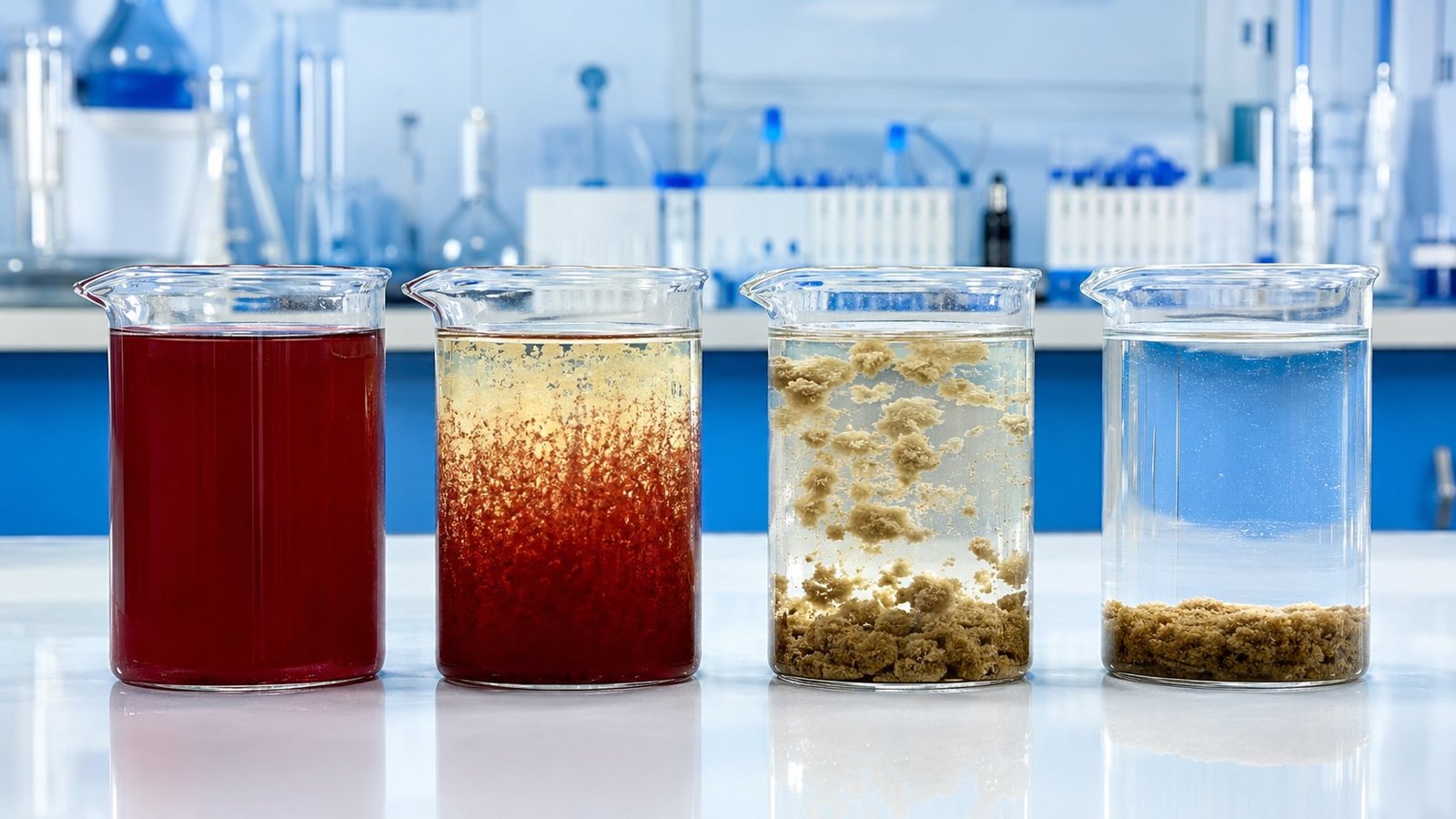
How to Remove Color from Textile Wastewater
Color removal normally requires chemical selection, pH control and jar testing with actual textile wastewater before bulk dosing.
Step 1: Check Wastewater Condition
- Confirm source: dyeing, printing, washing or mixed effluent.
- Measure pH and COD if available.
- Take a color photo for technical comparison.
Step 2: Test Decoloring Agent
- Dilute the water decoloring agent and add it to wastewater sample.
- Observe color reduction, floc formation and supernatant clarity.
- Record dosage and settling time.
Step 3: Optimize PAC and PAM
- PAC can improve coagulation and turbidity removal.
- PAM can make flocs larger and accelerate settling.
- Final sequence depends on actual wastewater.
Quick Selection Reference
Use this as a starting point only. Final dosage and sequence should be confirmed by jar test with actual wastewater.
| Situation | Typical Concern | Suggested Test Direction |
|---|---|---|
| No floc | Coagulation not enough | Test PAC addition |
| Small floc | Polymer support not enough | Test low-dose PAM |
| Color remains | Decolorizer dosage or pH not suitable | Adjust dosage and pH |
Related Technical Pages
Continue reading technical pages or submit wastewater information for sample support.
Jar Test Guide
Dosage Calculation
Sample Template
Need help choosing chemicals?
Send wastewater source, color photo, pH, COD, daily flow and current chemical process. We can suggest a jar-test direction for Water Decoloring Agent, PAC and PAM.